A gym cleaning checklist works when it is split by how often each job is done and by zone of the gym, and when every line names who does it and when. The lists below start from that: tasks to do when you open and close, tasks between classes and at busy hours, and tasks to do once a week and once a month, for the front desk, the machines, the free weights, the locker rooms and the mat area. They are a starting point to adapt to your floor, not a standard. What products to use, how strong, how long a surface stays wet, and what your area requires are questions for each product's maker and your local health authority, and this article does not answer them.
How to use the checklist
Copy the lists into a sheet you can print, and change them to match your floor. For each line, add three columns: who, when and a box to initial. A checklist with no names is a wish. Pin the daily sheet where staff will see it, such as behind the front desk or on the door of the supply closet, and keep the completed ones for a month so you can see what slips.
Two principles run through all of it:
- Clean by zone and in order. Work from cleaner to dirtier areas and from top to bottom, so you do not spread dirt to something you have already done.
- Use what the manufacturer says. Equipment upholstery, screens, rubber flooring and wood each have a maker with cleaning instructions. A product that damages a bench pad costs you more than the cleaner saved. Keep the instructions for each surface in the supply closet.
When you open
Before the first member walks in, someone should do a short walk through:
- Front desk: wipe the counter and the screens, check that the entrance floor is clean and dry, empty the bin.
- Floor: look for anything left from the night before, such as spills, loose weights, towels and trash.
- Machines and benches: do a quick visual check of pads, handles and seats, and report anything torn or loose.
- Locker rooms: check that floors are dry, toilets and sinks work, and soap and paper are stocked.
- Supplies: check that wipes or spray and cloths are out where members can reach them, and that bins have liners.
While you are open: between classes and at busy hours
The busiest hours decide how clean the place feels. Assign this to a named person each shift:
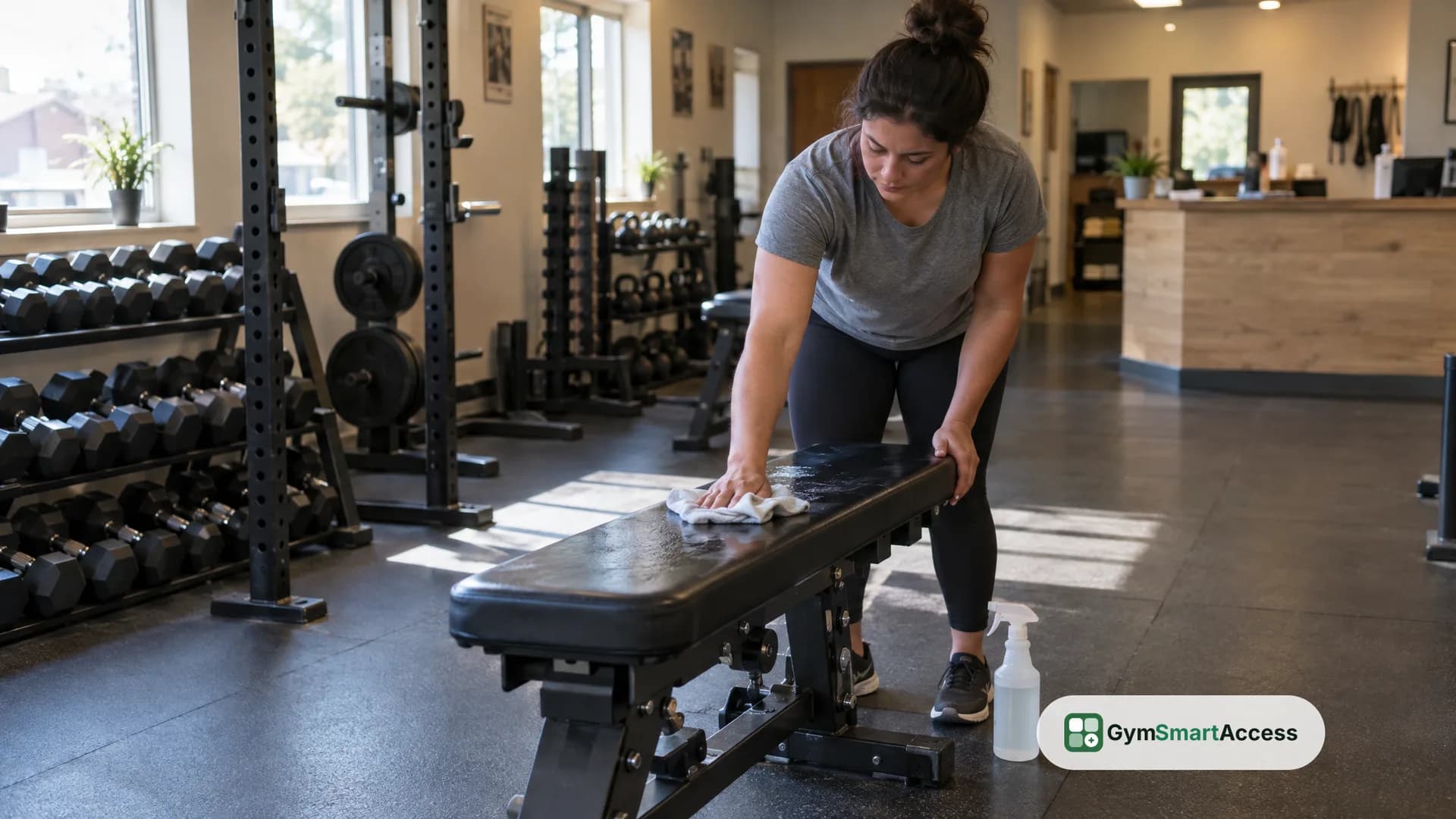
- Wipe down the equipment a class used: mats, bars, dumbbells, boxes, benches, handles.
- Empty bins that are full and restock towels, wipes and paper.
- Check the locker rooms at a regular interval, such as once an hour, and note it on the sheet.
- Wipe up spills right away and put out a sign for wet floors.
If you are not sure which hours are busiest, look at your own attendance. In GymSmartAccess, on the Professional and Enterprise plans, a heat map shows on which days and at what hours most people come in, for each location, so you can place a cleaning round before the rush. Without it, your team's own notes on the busy hours do the job.
How to clean gym equipment
Members can help, and you should ask them: put wipes or a spray and cloths near the machines, and a sign that asks members to wipe a surface after they use it. Do not rely on it. Staff still go around at a set interval.
For each type of equipment, write down:
- Cardio machines. Handles, screens, seats and the belt or pedals. Screens may have their own instructions from the maker. Look up each one.
- Strength machines and benches. Pads, handles, seat adjusters and anything a hand or skin touches. Check pads for tears, because a torn pad is hard to clean and should be repaired.
- Free weights. Handles of dumbbells, bars and kettlebells. Racks and the floor underneath.
- Mats and small accessories. Mats, bands, balls, foam rollers and straps. Some can be washed and some only wiped: follow the label.
- Cables, attachments and collars. Handles that many hands share.
Ask each maker how often they recommend a full clean, and add that to the weekly and monthly lists. If you cannot find instructions, ask the seller.
When you close
- Front desk: wipe the counter and the screens, empty the bins and tidy the area.
- Floor: put weights, mats and accessories back in place, and sweep or vacuum the floor.
- Machines: a final wipe of anything touched a lot that day.
- Locker rooms and restrooms: clean toilets, sinks and showers, empty the bins, refill supplies and mop.
- Laundry: collect used towels and cloths and start or schedule the wash.
- Supplies: write what is running low on the sheet.
- Lights, doors and windows: check that they are off, locked or closed as your routine says.
Every week
- Floors: a deeper clean of rubber or wood floors, including under and around equipment you can move.
- Equipment: a deeper pass over every machine, such as seams, adjusters, bolts and the places a cloth does not reach each day.
- Walls, mirrors and glass: wipe the surfaces members touch and the mirrors.
- Locker rooms: a thorough clean of benches, lockers, drains and ventilation grills.
- Laundry: wash cloths and any washable mats.
- Bins and supply closet: wash the bins, check stock and put the order in.
Every month
- Equipment inspection: check pads, cables, bolts and moving parts of every machine. Write what needs repair and who will call.
- Ventilation: check filters and vents, and follow the instructions of whoever installed or maintains them.
- Hard-to-reach places: behind and under machines, tops of lockers, light fixtures and ceiling vents.
- Pest control: ask a professional what your premises need, and keep their visit dates on the sheet.
- Review the sheets: look at the month's completed lists and ask what was skipped most and why.
Who does what
Put a name next to each zone for each shift. Many small gyms have one or two people on the floor at a time, so be honest about what they can do while also serving members. If the opening and closing lists take longer than the staff has, one of three things has to give: the list gets shorter, the shift gets longer, or someone else is hired to clean. Decide which one on purpose. If you contract a cleaning company for some tasks, give them the list and agree in writing on which ones they cover.
What to ask the people who know
- Each equipment maker: which products are safe for each surface and how often to clean.
- Your local health authority: what your area requires for a gym, its locker rooms and its showers.
- A cleaning supplier or contractor: how to store and label products and what a staff member must know before using them.
- Your insurer: what they expect in writing if a member slips or is hurt.
Write down the answers with the name of who gave them and the date, and keep them with the checklist.
Keep it up to date
A checklist is only useful when it is the one actually used. Review it after the first month, fix lines that are unclear, remove lines no one does and add the ones the sheet missed. Ask the team what is slowing them down. A short list done every day beats a long one done on good days.
GymSmartAccess does not keep cleaning checklists: this one lives on paper or in your own sheet. What it keeps is the rest of the daily record: the members, their plans, the payments recorded at the desk and entry by QR. To see it, read about the features, how it works and the pricing. The 30-day free trial needs no card.
Get organized without changing how you work
Members, check-ins and recorded payments in one place. 30 days free, no card.
Try it free