Opening a yoga studio comes down to five decisions you can make before you rent anything: which styles you will teach and who will teach them, how many mats the room holds, what the schedule looks like week by week, how you will charge (memberships, single classes or both), and whether the budget allows the full room or a smaller start. Yoga needs less equipment than a gym full of machines, so the room, the teachers and the schedule do most of the work. This plan puts the decisions in order for a small, independent studio and shows how to find your break-even from your own numbers.
Start with the offer: styles, teachers and who the room is for
A yoga studio is known for what is taught and by whom. Before looking at spaces, write down:
- The styles. A single style gives you a clear identity and a simple schedule. A mix of styles reaches more people but needs more teachers and a clearer timetable, so that a beginner knows which class to book.
- The teachers. How many you need for the weekly grid, who covers when one is sick, and what training you will ask of them. Ask the schools you respect and your city's offices what is expected in your area, because this article does not set it.
- The public. Office workers at lunch, parents after drop-off, older adults in the morning, people who only come on weekends. Each group sets the hours.
- Your difference from the studio down the street. Style, teacher, price, atmosphere, a particular day of the week. If you cannot say it in one sentence, the neighborhood will not either.
What it costs to open a yoga studio
A yoga budget is mostly floor and people. Get a written quote for each item below, and keep the name of whoever gave it and the date, because an average from another city tells you nothing about your street.
- Floor area. The deposit, the rent and any broker or legal fees, and what the lease lets you change. You pay for every square foot whether the class is full or not.
- Making the room quiet and warm. Flooring, lighting, sound, heating or cooling, storage for mats and props, a changing area and a restroom. If you plan heated classes, ask a contractor and the city what that room needs for ventilation and safety; do not assume.
- Props. Mats, blankets, blocks, straps and bolsters, counted for the largest class you will run, with spares for people who forget theirs.
- Teachers. What you will pay per class or per hour, and who covers absences.
- Permits and insurance. Which ones apply depends on where you are, so ask the city and the state, an accountant and an insurance broker; this article does not list them.
- Getting known. A sign, a simple website and what you will do for the first weeks.
- Software. The provider's pricing page, for the first month and the contract.
- A cushion. How many months of rent and teachers' pay you could carry with a schedule that is not yet full.
Yoga's equipment lines are small, but its space lines are not. That is why the number of mats in a room matters more than the number of rooms.
How many mats fit, and what that means for your classes
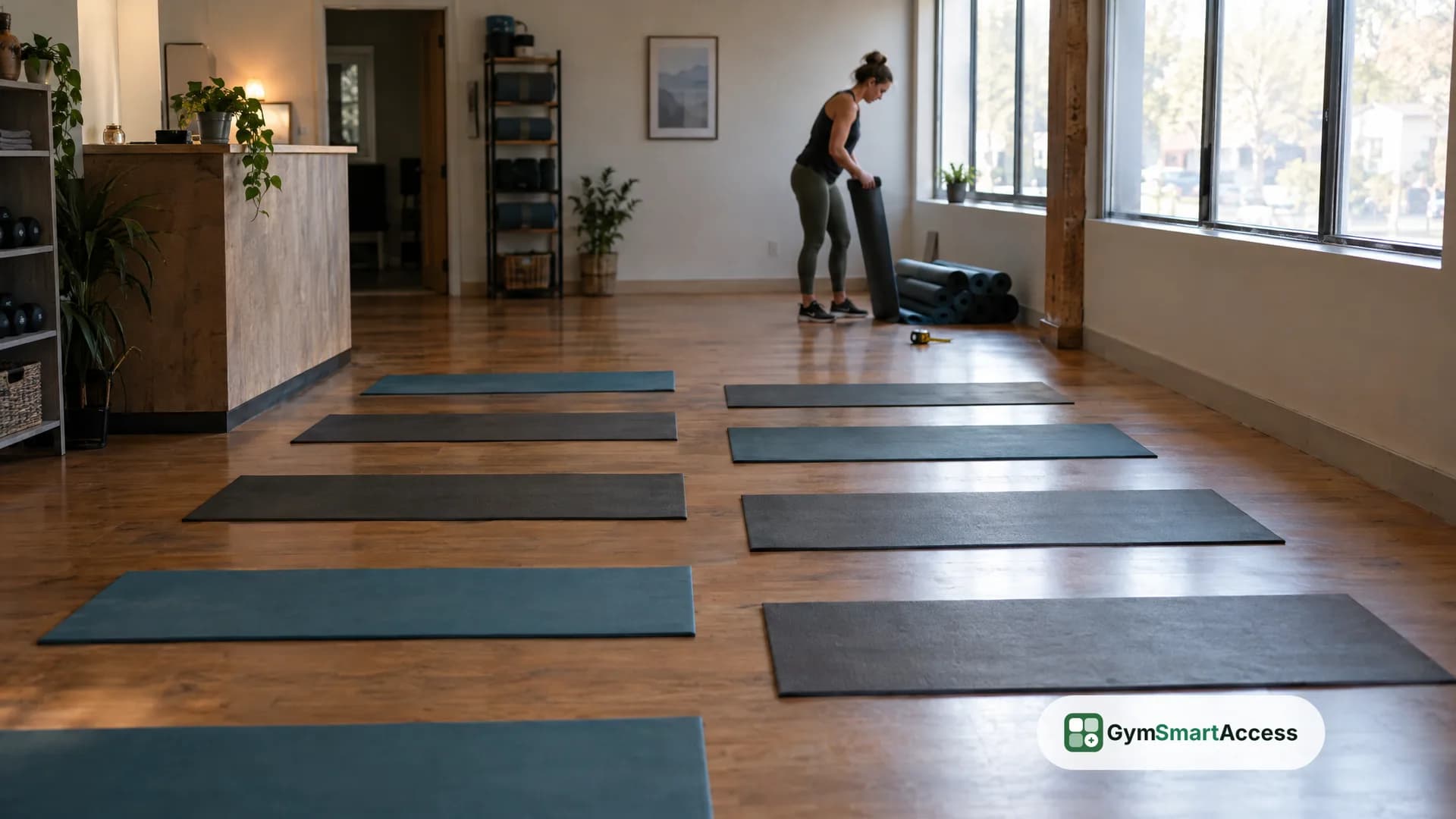
Capacity is your maximum revenue per class. Sketch the room with every mat in place, with enough space to move, for the teacher to walk through the room and for people to get in and out without stepping on a neighbor. The number that fits is your class size. Then:
- Count the rooms. One room means one class at a time.
- Decide the class size per style. A beginner class and a small-group class do not need the same number of people.
- Put the schedule on paper by day part. Early morning, midday, evening and weekend, with the style, the teacher and the capacity of each class.
- Plan for the class that fills first. A popular evening slot will run out of mats before the others. Decide whether the answer is a waitlist, a second class at the same hour in another room, or a bigger room later.
- Agree the house rules with your teachers. Arrival time, entering once class has started, and how much notice a student gives to free a place, written down before the first class.
How you charge decides the schedule
Yoga clients buy in different ways: a monthly membership, a single class, a set number of classes. Choose what you will offer before you build the schedule, because it changes how you read your numbers.
With memberships, revenue is predictable and your break-even is a number of members. With single classes, every class is its own sale and your break-even is a number of places filled. If you sell both, keep track of which one is paying the rent.
A yoga studio business plan in two numbers
For a membership studio, two numbers decide whether the plan works, and you can find both before you sign.
- Break-even members. Add up the monthly costs that stay put however many members you have: rent, teachers, insurance, software, utilities. Then work out what one member contributes in a month once you take off what that member costs you, like card fees. Divide, and round up.
- Members the schedule can hold. Multiply the mats in the room by the classes you will run each week, then divide by the classes an average member takes each week. That is how many different members your timetable can serve.
If the first number is close to the second, the studio only pays its bills with nearly every class full: add classes at hours people want, change the price or lower the fixed costs before you open. A plan for a lender or a partner also needs the market, the offer, the team and the risks, in the same order as any small business plan.
Opening smaller than the dream studio
You can open with less than the dream studio and still have a real one.
- Teach your first classes in a space you rent by the session, such as a community room or another studio's quiet hours, while you build a base of regulars.
- Start with a short timetable at the times you know people want, and add classes when those fill.
- Buy mats and props for the class size you have today, not the one you hope for.
- Add a second style or a second room only when a full class and a list of people waiting tell you to.
Where software fits in a yoga studio
When classes are the product, the system has to know about teachers, rooms and places. In GymSmartAccess, the studio builds its weekly timetable once, with the day, the hour, the teacher and the room of each class, and the classes appear on the calendar two weeks ahead. Each class has its capacity, and the studio chooses how many minutes before the start members can still book or cancel. Each teacher has a panel with their own schedule and the list of members in their classes.
Members book from their phone and never past the capacity; a member whose fee is past due cannot book. A full class keeps a waitlist that shows each person their place, and when someone cancels, the first in line gets the place and an email and app notice. Someone who takes the same class every week can book it once for all the weeks from the app, as long as the days their plan allows leave room for it, or ask the front desk to do it. The teacher or the front desk marks attendance on each class.
Members pay at the front desk (cash, a transfer or the studio's own card terminal), and the payment goes on their profile, which brings them up to date at once. In GymSmartAccess a plan lasts between one and twelve months and may cap the days a week; class packs are not offered, and nothing is charged for a late cancellation or a missed class.
See pilates and yoga studios, features and pricing. The free trial is 30 days, with no card.
Try it in your box or studio
Recorded payments, check-in and classes with capacity in one place. 30 days free, no card.
Try it free